OpenServ Platform
Agentic AI · SaaSOpenServ · 2024 – 2026
A platform for building, hosting, and orchestrating collaborative AI agents. Users assemble a team of agents in a shared workspace, hand it a goal, and oversee the work with human-in-the-loop controls and metered billing.
I helped build AI-powered agent workflows that automate real business processes end to end.
Context
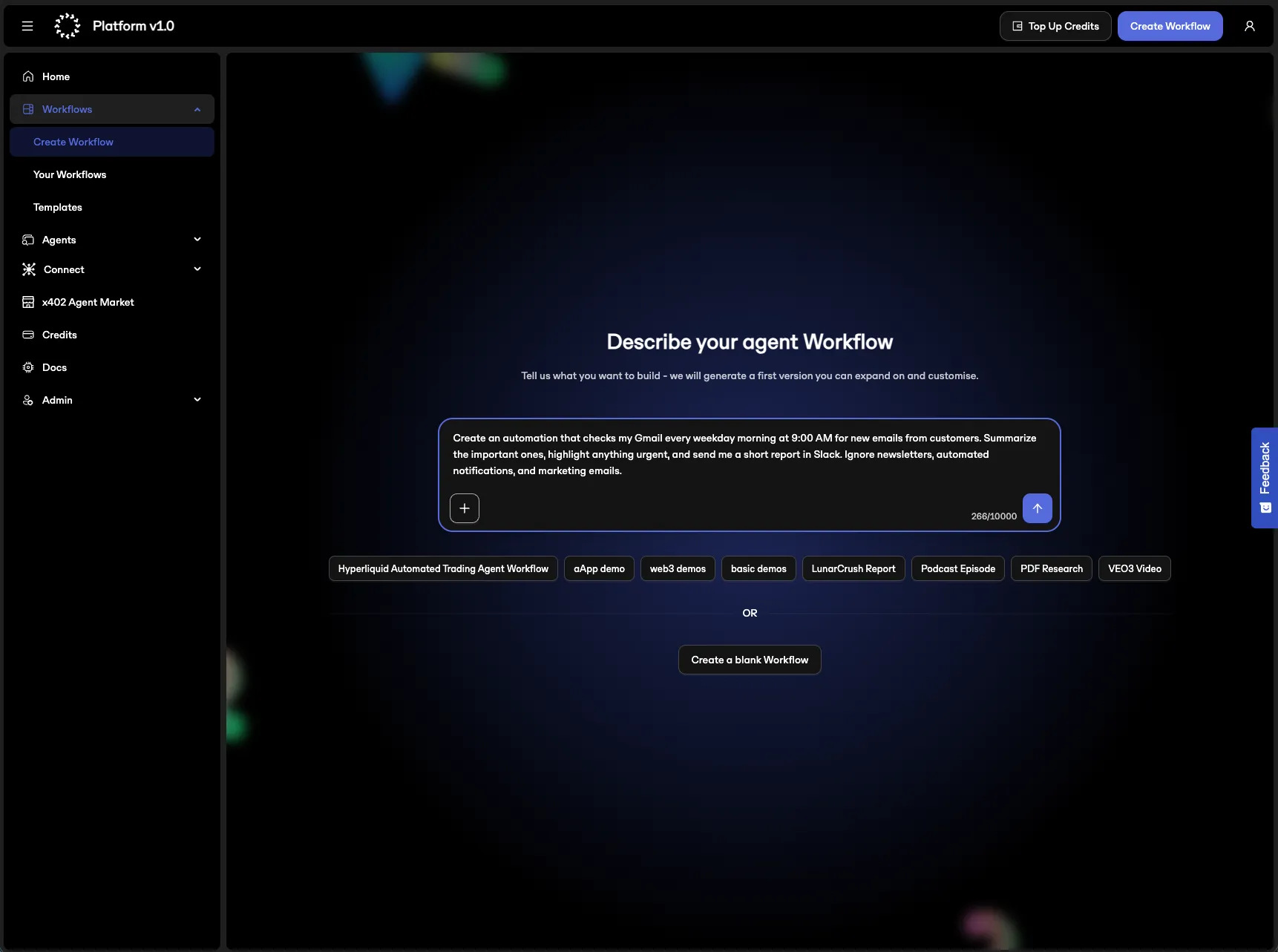
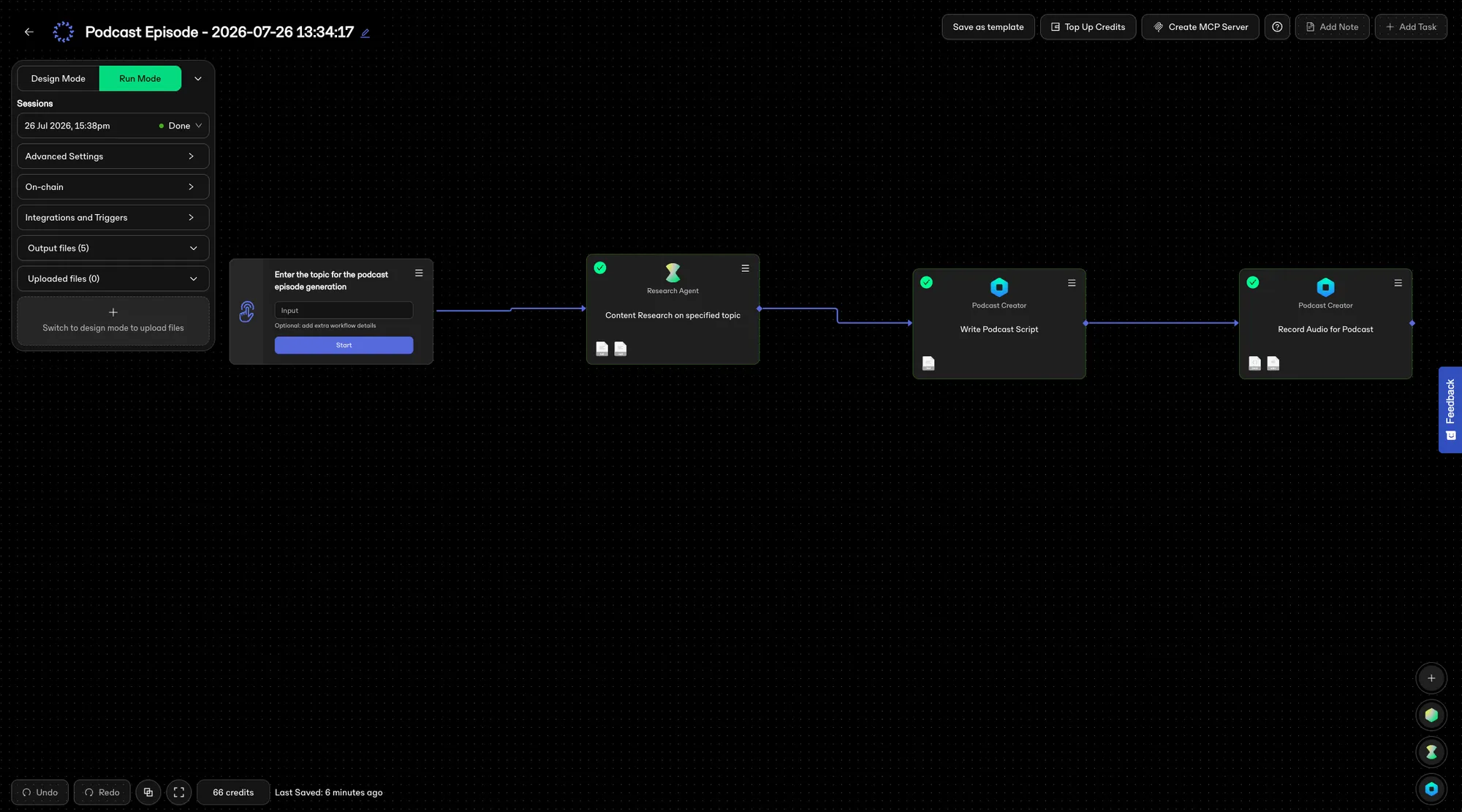
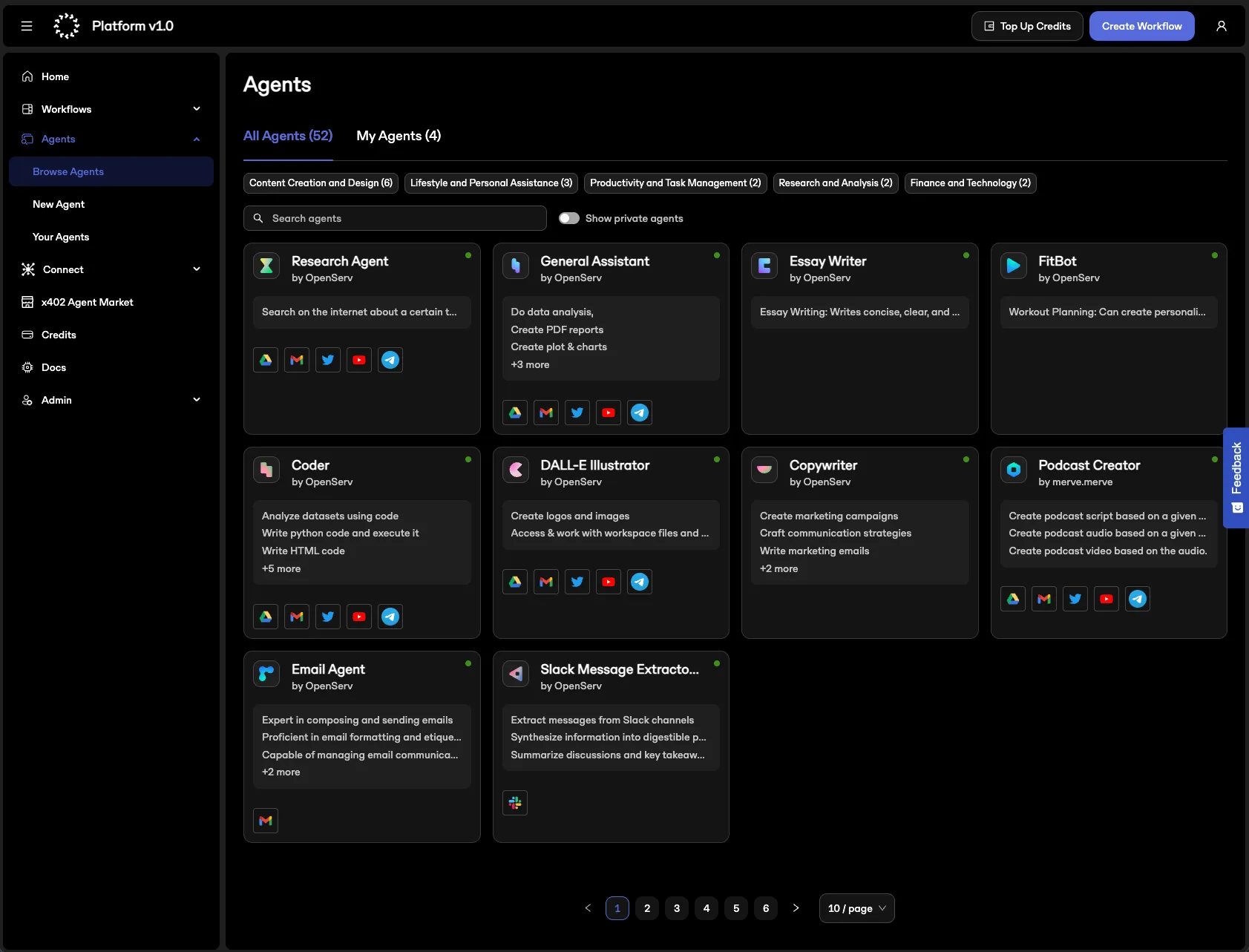
OpenServ Platform is a system for building, hosting, and orchestrating collaborative AI agents. Users assemble a team of agents from a marketplace, give it a high-level goal, and watch the agents break it into tasks, collaborate, call tools and third-party integrations, and produce results. A real-time task board, chat, and live logs show what the agents are doing, and a human-in-the-loop mechanism lets an agent pause and ask a person for a decision before it continues. Workflows can also be built by hand: assign agents to a workspace, create tasks for them, and run the whole thing manually, on a schedule, or through a webhook.
The platform serves two audiences at once: end users who run agent workspaces, and third-party developers who build, host, and publish their own agents. An agent can be written by a developer against the SDK or generated by an AI “Builder”, and both deploy onto the same isolated, billable runtime. The whole product lives in one large TypeScript monorepo coordinated by Turborepo: a React SPA, an Express API organized by business domain, a multi-agent runtime with a library of built-in agents, a Fly.io-based agent-hosting orchestrator, an embeddings service, and shared packages.
My role
Lead engineer on the product, involved from the beginning. I helped architect the entire solution and worked across the whole monorepo: the frontend, the API, the agent runtime, and infrastructure.
Highlights
- End-to-end multi-agent orchestration. A goal gets decomposed into tasks, agents collaborate and call tools and integrations, and artifacts come out the other side. All of it is observable in real time over socket.io, with human-intervention checkpoints along the way.
- Secure agent hosting. Untrusted third-party agent code runs in isolated, scale-to-zero Fly.io machines with per-second billing.
- Optional crypto capabilities on top. The platform isn’t crypto-first, but agents that want them get Web3 extras beyond the traditional tooling: their own crypto wallet (kept in an isolated sidecar their code can’t reach), pay-per-use payments between agents and services via the x402 standard, and an on-chain identity and reputation.
- Multi-provider LLM layer. A model router covers Anthropic, OpenAI, and Gemini through the Vercel AI SDK, with MCP and A2A interop and Langfuse tracing integrated.
- Agent-facing developer experience. The platform’s capabilities are also packaged as published, installable AI-agent Skills (
openserv-labs/skills) so coding agents in Cursor, Claude Code, and similar tools can build on and drive OpenServ directly.
Video & images